
Information you need to run your painting business in PaintClarity. Search below or browse by topic.
Instructional Videos
PaintClarity Walkthrough (full app tour)
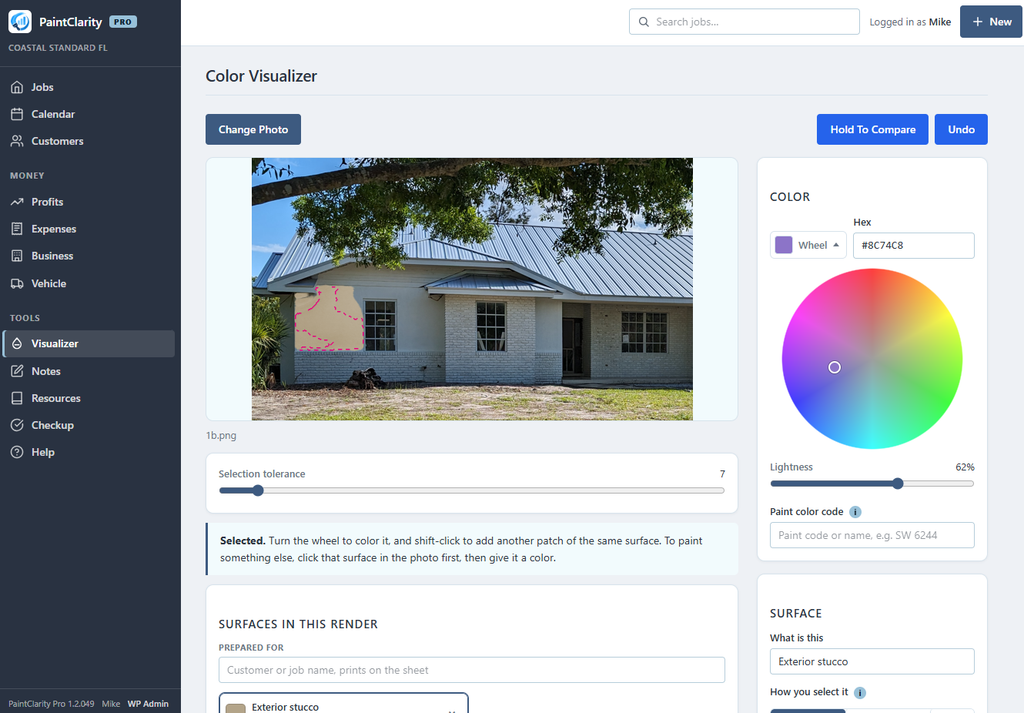
A practical five-minute tour of PaintClarity, from the first quote to the finished job. Follow a guest bedroom repaint through customer information, painting-specific quote tools and paint calculators, online quote acceptance, scheduling and crew assignment. Then see the painter’s field view, try paint colors with the Visualizer, and review the completed job’s profit and actual production rate.
Watch the walkthrough on YouTube
Jump to a section
- 0:11 Your active and upcoming jobs
- 0:31 Customer information
- 0:52 Painting quotes and paint calculators
- 1:29 The customer’s online quote
- 1:47 Scheduling, crew assignment and job instructions
- 2:17 Painter field view and offline viewing
- 2:51 Paint Visualizer
- 3:23 Job costs, profit and Job Pulse
- 3:53 Actual Production Rates
- 4:20 Free, Pro and room to grow
The walkthrough uses fictional customers and seeded demo jobs, and the Visualizer’s rendering time has been shortened. Color previews help narrow your choices; confirm the final color with a physical paint sample.
Getting Started
How Do I Use PaintClarity?
PaintClarity is designed to be simple, intuitive, and productive from day one. This quick guide will walk you through the basics so you can get up and running in just a few minutes.
When you’re done, be sure to read How to Get the Most Out of PaintClarity for practical tips and best practices to help you and your team get the most value from the platform.
Prefer to watch? The five-minute PaintClarity Walkthrough under Instructional Videos follows one job from quote to completion.
How to Get the Most Out of PaintClarity?
Read this guide to learn practical tips, best practices, and proven workflows that will help you and your team get the most value from PaintClarity.
What is PaintClarity?
PaintClarity is a WordPress plugin that turns your own website into the back office for a painting business. You can build professional quotes, schedule crews on a calendar, track jobs from lead to completed, keep customer records with before and after photos, log job expenses and receipts, and (on Pro) see the real profit on every job and track business overhead and mileage. It was built by a painter, for painters, and your data lives in your own WordPress database rather than a third-party cloud.
What do I need to run it?
For the core app, you need:
- A self-hosted WordPress site running WordPress 6.2 or later
- PHP 7.4 or later
That’s it. A few optional features connect to outside services, and only if you turn them on:
- Online card deposits use your own Stripe account (Pro).
- The AI tools use your own OpenAI key (Pro).
- Address autocomplete uses a Google Maps key.
We also strongly recommend running your site over HTTPS, which the phone app and online payments require.
Not sure which WordPress or PHP version you have? Your web host can tell you.
How do I install and activate PaintClarity?
Install it like any WordPress plugin: from your dashboard go to Plugins, Add New, search for PaintClarity, then Install and Activate. On activation PaintClarity automatically creates the one page your whole app runs on. If you ever need to recreate that page, you can do it from PaintClarity, Settings under Setup Health, App Page.
Where is the app after I install it?
PaintClarity runs from a single WordPress page that holds the shortcode [paintops_app]. It is created for you on activation. Everything (quotes, calendar, jobs, customers, photos, financials) lives on that one page and routes internally, which keeps your admin menu tidy. You will find the link to it under PaintClarity in your WordPress admin.
How do I set up my company profile?
Go to PaintClarity, Business in your WordPress admin and open Company Profile. Set your business name, address, phone, email, website, logo, country, currency, and units. This information fills the header of your quotes and invoices, the quote email signature, and your pricing suggestions, so it is worth completing before you send your first quote.
What is included free, and what is Pro?
Free runs the job from first call to final payment:
- Quotes and estimates with a scope-aware builder, inclusions and exclusions, itemized or lump-sum pricing, printable PDF and email
- Send a quote by link. The customer opens it on their phone, sees the full itemized version, and accepts by typing their name as a signature, or declines with a reason. Taking a card deposit is the Pro part
- Scheduling calendar, crew assignment, and a calendar subscription for Google, Apple or Outlook
- Job board and pipeline, customer records, before and after photos, job notes with camera
- Crew tools: time clock check-in and check-out, time off, worker notifications, and permissions that keep money out of painters’ hands
- Job cost tracking: log expenses, hours and payments against a job
- Job receipt logging (receipts on a job’s expenses), paint colors per job, follow-ups, and a communication log of everything you sent
- Trade calculators and a price list
- Color visualizer, business notes, crew resources and Business Checkup
- Offline access in the field
- Data export and erase tools, and your customer quote and invoice pages are kept out of search engines
- Unlimited jobs, quotes, painters and admin users. No monthly limit
Pro is $45 per month per site and adds the money side:
- Profit and margin reporting per job, per crew, per worker and by job classification
- The Profits dashboard and Job Pulse
- Invoicing: create, number and send invoices
- Online card deposits and invoice payments through Stripe
- AI tools: estimate from a photo, scan a receipt, and get feedback or a rewrite on your quote wording, using your own OpenAI key
- Vehicle mileage and expense log
- Overhead and business expenses, with a year summary
- Vendor spend and 1099 reporting, and duplicate receipt detection
- Year-end reports for your accountant
- Priority support
The short version: free tracks the work and the money going in and out of each job. Pro adds your business-wide books (overhead, mileage, vendor spend) and tells you what it all meant.
Quotes
How do I build a quote?
Start a new request, enter the customer and the job, then open the quote builder. It understands painting work: you pick interior or exterior scope components, add standard inclusions and exclusions, and choose itemized line items or a single lump sum. Built-in trade calculators can figure quantities and drop the numbers straight into the quote. When it looks right, you can print it, save it as a PDF, or email it to the customer.
What are inclusions and exclusions, and why do they matter?
Inclusions spell out exactly what the price covers, and exclusions state what it does not, which is what keeps you out of disputes later. PaintClarity ships with a reusable library of painting-specific scope and exclusion language you can drop onto any quote and edit, so every quote reads clearly and consistently. You manage the library under PaintClarity, Business, Exclusions Library and the per-category scope components.
Itemized or lump-sum pricing, which should I use?
Both are supported on every quote. Itemized shows the customer a breakdown of line items, which builds trust on larger jobs. Lump sum shows a single total, which is cleaner for smaller work. You choose per quote, so you can match the format to the customer.
How do I send a quote to a customer?
From the quote you can email it directly to the customer with a clean PDF, or print or save the PDF and send it yourself. The email uses your company profile for the signature. If your quote emails are landing in spam, see the email deliverability article, connecting an SMTP service fixes it.
How does a customer accept a quote?
Every quote can be shared as a private link that opens a customer-facing page with no login. The customer reviews the quote, ticks any optional add-ons you offered, signs on the page, and that is the acceptance. On Pro they can pay the deposit by card at the same moment through your Stripe account; on the free plan you record the deposit yourself when it arrives.
What happens next. The customer gets a short email from your business confirming what they signed: the total, the deposit due or the amount due on completion, and their quote link. When a deposit is paid online they get a receipt for it. You get an email too, and the quote becomes a job on your schedule. If an add-on was ticked, it is folded into the job the moment the acceptance is recorded (when the deposit lands, for an online deposit).
A customer who signs but closes the card page before paying has not accepted yet; Communication History shows them as “signed, deposit not paid” so you can follow up. If you win a job over the phone instead, mark it won by hand and the quote page reads “This job is on our schedule”, with the Pay the Deposit Online button still offered.
How do I revise a quote?
When the customer wants a change, revise the quote rather than starting a new one.
- Open the job.
- Create a new quote revision.
- Make your changes and send it as usual.
PaintClarity keeps every revision, and the job always points to the latest one. You get a full history of what changed, and the customer only ever sees the current version.
You can revise as many times as you need. The free plan has no monthly limits on quotes or revisions.
What is the difference between a quote, an estimate, and a bid?
In the painting trade, people use all three words for the same piece of paper, and customers don’t always know which one they’re holding. The usual meanings:
- Estimate: a rough figure, offered before a full look at the job, not a price you’re bound to. “Probably around $3,000.”
- Quote: a fixed price for a described scope. If the customer accepts it, that’s the price, unless the scope changes.
- Bid: a quote submitted in competition, usually to a property manager, builder or commercial customer who is collecting several. Often on their form and their deadline.
What matters for you: an estimate leaves room to adjust, and a quote or bid doesn’t. A document that spells out what’s included and what isn’t protects both sides. That’s why PaintClarity’s quote builder has inclusions and exclusions built in.
In PaintClarity, all three are the same record. You pick the label the document should carry (Quote, Estimate or Bid), and the customer page, the PDF and the email all use that word. When the customer accepts it, the same record becomes the job, with nothing to re-enter. A revision replaces the old version, so the customer only ever sees the current one. Each document carries a valid-until date, the email states the total, and the customer signs an accepted document on their own phone.
There’s no limit on how many you create. The free plan includes unlimited quotes, estimates and bids, with no monthly cap.
A good habit: call your first number an estimate if you haven’t seen the job, and send a quote once you have.
Scheduling & Jobs
How do I schedule a job and assign a crew?
Put the job on the calendar with a start date, how many days it needs, and a start time, then assign the painters and helpers who will work it. Assigned crew members can open the job from their own login (and from the notification email) to see the address, scope, colors, and notes.
What is the job board or pipeline?
The board gives you a simple three-column view of your work: Quotes, Active Jobs, and Completed. It is the fastest way to see where everything stands and move a job from quote to active to done. On Pro, active and completed cards also show a balance-due or paid-in-full tag.
Can I subscribe to the schedule from my phone calendar?
Yes. PaintClarity publishes a private calendar feed you can subscribe to from Google Calendar, Apple Calendar, or Outlook, so your PaintClarity jobs show up alongside the rest of your day. Keep the feed link private, since anyone with the exact link can view the schedule.
Can I add my own holidays to the calendar?
Yes. Under PaintClarity, Settings, Calendar Holidays you can add the days you close for, including fixed dates and floating rules like “the fourth Thursday of November,” and there are one-click US presets to get you started.
How do I schedule a callback or punch-list visit?
Schedule the follow-up visit from the original job, so the two stay linked.
- Open the original job.
- Schedule a follow-up visit, such as a callback or punch-list trip.
- Set the date and save. The visit shows on the calendar like any other visit.
The follow-up is its own record, tied back to the original job. You can schedule as many as you need. The free plan has no monthly limits.
Callbacks and punch-list visits are left out of your Production Rates, so a quick touch-up trip won’t skew your numbers.
Customers
How do customers request a quote from my website?
Add the quote request form to any page with the shortcode [paintops_quote_form]. A contact page is the usual home for it. Someone who fills it in becomes a lead inside PaintClarity instead of an email you have to remember to answer.
The form always asks for a name and what they need done. Email, phone, property address, type of work and how they prefer to be reached can each be required, optional, or left off under PaintClarity, Settings, Quote Request Form. You can add up to six questions of your own there, and choose whether to be emailed as each request arrives or once a day.
New requests appear at the top of your Jobs page and on the Leads screen.
Open one and use “Convert to Request”. If the person already looks like a customer you have, PaintClarity puts the two records side by side and asks whether it is the same person before it links them. Nothing is saved until you create the request, so you can back out at any point.
Junk is flagged and kept in your Spam list, never thrown away, so a real customer is never lost to a bad guess.
Quote requests are part of PaintClarity Pro.
What does the customer receive by email? Free
PaintClarity sends your customer a short email from your business at each step, so you do not have to:
- The quote, with the total, the valid-until date, the PDF and the link to their quote page. Sending it again after they have accepted says so instead of repeating the ask.
- After they sign: a confirmation of what they accepted, the deposit due or the amount due on completion, and their quote link.
- When a deposit is paid online (Pro): a receipt for it.
- The invoice (Pro), with a link to view and pay it, and a receipt once it is paid.
- Follow-ups you schedule, greeting them by first name.
Every email uses your company profile for the name, logo and signature. If they are landing in spam, connect an SMTP service; see “My quote emails are going to spam”.
Where are my customer records?
The Customers area is a directory of everyone you have worked with: contact details, service address, and full job and quote history. On Pro you also see each customer’s lifetime value. Customers are stored as plain records in your database, never as WordPress user accounts, so no one gets a login they did not ask for.
How do I delete a customer?
Open the customer and use the “Delete this customer” panel at the bottom (administrators only). This is a full, permanent wipe: it removes the customer and every job and quote linked to them, along with all attached estimates, financials, expenses, hours, payments, photos, receipts and invoices. It cannot be undone, so take a database backup first if the customer has real history.
Use this for a test entry, a duplicate, or a record you are certain you will never need again.
If a customer has asked you to remove their personal information, use Tools, then Erase Personal Data instead. That clears their details without destroying the financial records you are required to keep. See “How do I remove a customer’s data on request?”
Crew & Team
Production rates: what yours actually is, and how to use it Free
Your production rate is how much area one painter covers in one workday, measured in square feet per painter-day across the crew. The Rates page works yours out from jobs you’ve already finished, using two things PaintClarity already has: the hours your crew logged and the job’s Paintable Area.
How it’s worked out
- PaintClarity adds up the hours every worker logged on the job.
- It divides those hours by your workday length (PaintClarity, Business, Pricing Rules; default 8 hours) to get painter-days.
- It divides the area by those painter-days.
A 2,400 sq ft job with 60 hours logged, on an 8-hour day, is 7.5 painter-days: 320 sq ft per painter-day.
The headline figure is the median (the middle value) of your last 10 completed original jobs, not the average, so one mistyped number can’t drag it. You can set it to look at the last 5, 10, 20 or 50 jobs instead. There are also separate figures for each job category and classification.
Callbacks and punch-list visits aren’t counted, and neither are jobs with no area or no hours logged. Results below 25 or above 2,000 sq ft per painter-day are flagged and left out unless you include them, and you can exclude any job yourself. A figure built from fewer than 3 jobs is marked “thin evidence”.
The page measures. It doesn’t change anything. The rate your quotes are built from is the one you set under PaintClarity, Business, Pricing Rules, or per job category under Job Categories. The Labor Days and Crew Cost Calculator starts from that figure and tells you which one it used.
To use your measured rate:
- Open Rates under Tools in the menu.
- Compare your measured rate with the rate you quote from. When they disagree, you decide why: you know what happened that month, and the arithmetic doesn’t.
- If you want to quote from the measured number, click Use measured rate to copy the median into your settings.
Rates is in the free plan, for office staff only. Painters and helpers don’t see it.
How do I add a painter or helper?
A team member just needs a WordPress account, then you enable them under PaintClarity, Painters/Helpers. You can create the account yourself under Users, Add New (WordPress emails them a set-password link), or let them self-register if you have registration turned on. Once added, they get the Painter/Helper role and only see what you allow.
What can painters and helpers see and do?
Every painter or helper can view their own assigned jobs, open the emailed job link, see those jobs’ photos and notes, and check in and out. Beyond that, each person has opt-in permissions you control:
- Upload photos (on by default)
- Can upload receipts: log an expense and attach a receipt photo on their assigned jobs (on by default)
- Create jobs (off by default)
- Create quotes (off by default)
- View financials (off by default)
You set these per person on the Painters/Helpers page. A painter opens only the receipts they filed themselves, and never sees a job’s money unless “View financials” is on for them.
The office side (every job, customer, lead, quote and report) is for WordPress administrators. Someone who only needs to see their own jobs should be a painter or helper, not an administrator.
Do my painters see my profit and pay numbers?
No. Money figures (costs, profit, margin, and pay rates) are owner-level and hidden from painters and helpers unless you explicitly grant a specific person the “View financials” permission. A crew member logging hours or a receipt never sees the job’s profitability.
How does the Time Clock (check-in and check-out) work?
On a job, staff and assigned crew can tap Check In when they arrive and Check Out when they leave, and their hours are logged to that job automatically. It even works with no signal and syncs when they reconnect. Hours flow into the job so labor is tracked without anyone typing timesheets.
Can I turn the Time Clock off?
Yes. If you track hours another way, go to PaintClarity, Business, Time Clock and switch it off. The check-in and check-out box then disappears from every job. Any hours already logged are kept. Administrators can still add or correct hours by hand on the job’s Hours page (any plan) or, with Pro, in the Hours section of Job Financials.
How do worker notifications work?
When enabled, PaintClarity emails each assigned painter or helper a “job starts tomorrow” reminder the day before, with the address, customer, and time. It runs automatically once a day. You turn it on under PaintClarity, Business (or Settings), and there is a backup trigger URL for very low-traffic sites where the daily task can be unreliable.
How long do team members stay logged in?
WordPress normally signs people out after a couple of days, which is a nuisance for a crew checking job details on a phone. Under PaintClarity, Settings, Team Login Duration you can extend how long staff and crew stay logged in. Longer is more convenient but means a lost phone stays signed in longer, so if a device goes missing, change that person’s password to log them out everywhere.
Photos
What does the Visualizer do?
Available on free and pro plans. Add a picture, such as the front of the house or an interior space to select and choose colors to present to the client. This is a screenshot of a house. Select a color, and then the areas, such as stucco to colorize that area.
How do I add photos to a job?
Open a job’s Notes & Photos and take a photo with your phone camera or choose one from your library. It uploads as soon as you pick it, stamped with the time and who added it, and compressed on the way in so it does not bloat your site. Add a note with it if you like; notes and photos share one log, newest first.
Who can see them. A job’s photos open for you and for the painters assigned to that job, and for nobody else. Since version 1.2.081 photos are kept in a private folder on your server rather than the WordPress media library, which sat at a web address that worked for anyone who had it. A photo you add to an invoice still shows to the customer holding that invoice link.
Where they show up. On the job page as a strip of thumbnails, on Notes & Photos, in the Before/After pairs, as a starting image for the Visualizer, and as an option when you raise an invoice.
Photos from before 1.2.081. Those are still in the media library until you move them. Checkup shows a “Move photos and receipts into private storage” card with the count and a button; it runs in batches of 100 and you can stop and continue any time. Nothing stops working while it runs.
Photos can be JPG, PNG, GIF, WEBP or HEIC. Each job has a photo limit you can raise under Business > Company Profile.
How do before and after photos work?
Add a “Before” photo, then tap “Take Matching After Photo.” A live camera overlay shows the Before shot as a faint ghost so you can line up the exact same angle, then it captures and pairs the two automatically. Afterward you get a drag slider to reveal one photo over the other, which is great for showing customers the transformation. You can also pair two photos you already have.
Expenses & Money
What do Production Rates tell me? Free
Production Rates shows how fast your crew really paints, measured from jobs you’ve already finished. The answer is in square feet per painter-day: how much area one painter covers in one full workday, across the whole crew. It’s the difference between quoting from a rule of thumb and quoting from your own crew’s pace.
Production Rates is included in the free plan. Only office staff can see it; painters and helpers can’t.
How the number is worked out
PaintClarity uses two things it already has: the hours logged on each job and the job’s Paintable Area.
- It adds up the hours every worker logged on the job.
- It divides those hours by your workday length to get painter-days. The workday length is set under PaintClarity, Business, Pricing Rules; the default is 8 hours.
- It divides the job’s area by those painter-days.
Example: a 2,400 sq ft job with 60 hours logged, on an 8-hour day, is 7.5 painter-days. That’s 320 sq ft per painter-day.
The headline figure
The main number is the median (the middle value) of your last 10 completed jobs, not the average. One mistyped number can’t drag it up or down. You can change how many recent jobs it looks at: 5, 10, 20 or 50.
You also get separate figures for each job category and job classification, so you can compare, say, interior repaints with exterior work.
What’s left out
- Callbacks and punch-list visits. Only original jobs count.
- Jobs with no area or no hours logged. Use “Add area” or “Add hours” on a row to fill the gap.
- Unusual results. A job that works out below 25 or above 2,000 sq ft per painter-day is flagged and left out, unless you choose to include it. That catches typos, like a missing zero.
- Any job you choose to exclude. For example, a job that went sideways for reasons that won’t repeat.
If fewer than 3 jobs count toward a figure, it’s marked “thin evidence”. Treat it as a hint, not a rule.
Using it on your quotes
Production Rates never changes your quotes by itself. Your quote calculators keep using the rate you set under PaintClarity, Business, Pricing Rules (or per job category under Job Categories). A measured rate carries the weather, the access and the one job that ran long, and only you can weigh those.
When you trust the number:
- Open Rates in the menu.
- Compare the measured rate with the rate you quote from.
- If you want to quote from your crew’s real pace, click Use measured rate. That copies the median into your settings.
Want the long version? Read the full guide to production rates.
How do I log an expense and a receipt? Free
From a job, use Add Expense to record the vendor, category, amount and date, and attach a photo of the receipt straight from your phone. Logging expenses and receipts on a job is included free, so you can track what a job cost even without Pro. Business expenses that belong to no job (overhead) are Pro.
Who sees what. The office sees every expense and every receipt. A painter sees the receipts they filed themselves, never a colleague’s, and never the dollar figures unless you have given that person the “View financials” permission. Receipt images are kept in a private folder on your server and open only through PaintClarity’s own permission check.
Receipts can be a photo or a PDF, which covers emailed receipts and the account statements a paint store sends. Pro only: Business > Expenses handles overhead that belongs to no job, the Vehicle Log tracks mileage, vendor spend and duplicate-receipt detection keep your receipts in order, and the year-end report lists every receipt by category for your accountant.
How do I see the profit on a job? Pro
Profit on a job is what the customer paid you minus what the job cost you: materials, the receipts your crew filed, and the hours your painters logged at their pay rates. PaintClarity works it out for you as the job runs, so you do not have to wait for the books to close to know whether a job made money.
On one job. Open the job and choose Financials. The top of the page shows Billable (what the job is bringing in), the costs logged against it, the profit and the margin. Underneath are the pieces: materials and other expenses with their receipts, labor from the hours log, and any add-ons the customer accepted. Edit Billable here if the scope grew and you billed more than the quote.
Across every job. Profits in the menu lists your jobs with their profit and margin, totals them by month, and lets you leave out jobs you have marked “exclude from reports”. The tax you billed is shown on its own so it is never mistaken for income.
While the job is underway. Job Pulse compares the hours logged so far against the hours the quote assumed, so you see a job sliding before it finishes rather than after. Rates in the menu (Production Rates, included free) turns your completed jobs into square feet per painter-day, by job category and classification. That’s how you check the rate you quote with against the pace your crew really works at.
What feeds the numbers. Three things, and all three are free to log: the quote (or Billable, if you changed it), expenses and receipts filed on the job, and hours. Set each painter’s pay rate under Painters/Helpers so labor costs what it really costs. Painters and helpers never see any of these figures unless you give a specific person the “View financials” permission.
Financials, Profits and Job Pulse are Pro. Production Rates is included in the free plan for office staff. On the free plan you can still log every job expense, receipt and hour, on the job’s Add Expense and Hours pages, so the day you upgrade, the history is already there. Business expenses and overhead, the Vehicle Log, vendor spend and duplicate-receipt detection are Pro.
What reporting does Pro add? Pro
Pro includes a set of money reports:
- A Profits dashboard with profit and margin across your jobs
- Profit by classification and category
- Profit-per-hour rankings, so you see which work and which crews pay best
- Outstanding balances and a business financial report
- Business overhead expense tracking, a vehicle and mileage log, and accountant-ready tax reports with receipts
Can I send invoices? Pro
Yes, on Pro. From a job you can raise a numbered invoice for the remaining balance (or a progress invoice for part of it), add photos and notes from the job if you want the customer to see the work, email it, and give the customer a link to view and pay it online. Invoices carry your company branding and pull the balance straight from the job.
Payments are matched to invoices automatically: once the payments recorded since an invoice was raised cover it, it flips to Paid, and the Email button on a paid invoice sends a receipt. A refund does not reopen an invoice; if the scope changed, lower Billable on Financials instead. If a customer overpays, the Payments page says so by how much.
A cancelled invoice keeps its link alive with a note that it was cancelled and, if you replaced it, a link to the current one, so a customer holding the old number is never left guessing.
Payments
How do I collect a deposit?
Set your deposit rule once under Pricing Rules in Settings: a percentage of the job, or a higher percentage of the first part of it (the quote then reads, for example, “35% of the first $4,000”). Every quote carries that figure.
On the free plan you collect the deposit in person or by transfer and record it on the job’s Payments page. On Pro the customer can pay it by card when they sign the quote, through your own Stripe account, and the payment is logged against the job and receipted to the customer automatically. Either way the deposit shows on the quote page after acceptance, with the balance still due.
When you later raise the balance invoice, it prints the whole job, a “Deposit received, applied to the balance” line and the tax on the whole amount, so a property manager or a GST registrant gets one document with the full tax figure on it.
How do I set up online card deposits with Stripe? Pro
Under PaintClarity, Settings, Stripe Payments, add your own Stripe keys. Money is processed through your Stripe account and lands in your bank, PaintClarity just creates the checkout and records the payment. Online payments require your site to be on HTTPS, which Stripe enforces for live charges.
AI Tools
What can the AI tools do? Pro
On Pro, with your own OpenAI key, PaintClarity can:
- Estimate room dimensions and draft a description of work from a photo
- Scan a receipt photo to auto-fill the vendor, amount, and date
- Give you feedback on, or a professional rewrite of, your quote wording
AI output is a starting point to review, not a guarantee, so check it before it goes to a customer.
How do I set up the AI features, and what do they cost? Pro
The AI tools use your own OpenAI account, so you connect an OpenAI API key under PaintClarity, Settings, AI Settings. You pay OpenAI directly, typically a fraction of a cent to a few cents per action, and PaintClarity adds monthly usage caps you control so costs stay predictable. Nothing is sent to OpenAI unless you click one of the AI buttons.
Mobile & Offline
Can I install PaintClarity on my phone?
Yes. PaintClarity is an installable app: open it in your phone browser and use “Add to Home Screen” to get an app icon that opens full screen, no app store needed. This requires your site to be on HTTPS.
Does it work without a signal?
Yes, within limits. Once installed, the app lets crews keep reading jobs they have opened (address, scope, colors, notes) with no signal, and today’s scheduled jobs are pre-loaded for offline use. Check-in and check-out also work offline: the punch is queued on the phone and synced when the connection comes back, logging the time it was actually tapped. Creating quotes and other changes need a connection.
Why does PaintClarity need HTTPS?
Browsers only allow the offline app, the home-screen install, and live card payments on a secure (HTTPS) site, and HTTPS also encrypts customer and login details in transit. Most hosts offer free SSL with a one-click toggle, or a plugin like Really Simple SSL can handle it. PaintClarity still runs over plain HTTP, but those specific features will not work until you switch to HTTPS.
Settings & Admin
Can I put the quote request form on a website that is not WordPress? Pro
Yes. The quote request form and Leads are part of PaintClarity Pro.
The form normally goes on a page of your PaintClarity WordPress site, using the [paintops_quote_form] shortcode. If your public website lives somewhere else (Squarespace, Wix, a plain HTML site, a landing-page tool), you can put the form there instead:
- In PaintClarity, open Settings > Quote Request Form.
- Expand Advanced: use the form on another website.
- Copy the small piece of code shown there.
- Paste it into the page on your other website where you want the form, then save or publish that page.
- Send yourself a test request to make sure it arrives.
The form loads from your PaintClarity site and resizes itself to fit the page it sits on. Each request comes into PaintClarity as a lead, with a note of which page it came from. If you have Turnstile spam protection turned on, it works there too. Requests arrive under Leads, exactly as they would from your WordPress page.
On the free plan: wherever the [paintops_quote_form] shortcode sits, visitors see nothing. Administrators see a short note that the quote request form is a Pro feature. Upgrade to Pro to turn the form on.
How Can I Migrate My PaintClarity Data?
If you’re moving your PaintClarity website to a new hosting provider, changing your domain name, or moving to a new WordPress installation, this guide walks you through the recommended process.
Who can use the office side of PaintClarity?
The office side, every job, customer, lead, quote, invoice and report, is for WordPress administrators. Leads, invoices and reports are Pro. Painters and helpers get their own screens: their jobs, the time clock, photos and notes, and receipts, with the extra permissions you switch on per person.
Until version 1.2.080 any WordPress user who could edit posts (an Author, Contributor or Editor) was treated as office staff. If you had set someone up that way to run the office, make them an administrator under Users; if they only need their own jobs, add them as a painter or helper instead.
What is Setup Health?
Setup Health is a status board at the top of PaintClarity, Settings that shows, at a glance, whether each core piece of your install is set up: your app page, timezone, HTTPS, the offline app, your Google Maps key, notifications, and email. Anything that needs attention is flagged, and you can fix each item right there.
My dates and times are wrong. How do I fix that?
PaintClarity shows every date and time in your site’s timezone. If times look off by a few hours, the cause is almost always the WordPress timezone setting. Go to Settings, General, Timezone and pick your city (for example New York or Los Angeles) rather than a fixed UTC offset, then Save. Setup Health, Date & Time also shows the current time and warns if you are on a fixed offset that will not adjust for daylight saving.
Do I need a Google Maps key?
Only if you want address autocomplete, an embedded map on the job, and address geocoding. Add a key under PaintClarity, Settings, Google Maps. Without a key you simply type addresses by hand, and the “Get Directions” links still work, so the key is optional. Get / manage a key and restrict it to your site’s domain.
My quote emails are going to spam. What should I do?
By default WordPress sends mail through your web host with a basic method that many inboxes now flag as spam. The fix is to install a free SMTP plugin (such as WP Mail SMTP or Post SMTP) and connect it to your email provider so messages are authenticated. PaintClarity, Settings, Email Deliverability tells you whether SMTP is detected and includes a “Send Test Email” button.
Can I change how the app looks?
Yes. PaintClarity includes a set of visual themes (light, dark, industrial, and more) that you can switch site-wide under PaintClarity, Settings, Appearance.
How do I back up or export my data?
From PaintClarity, Business > Backup & Data you can download a ZIP export of your PaintClarity records (every table as CSV plus your settings). That is records only: no photos, receipts or documents are in it.
For a complete, restorable backup use a WordPress site-backup plugin that copies the database and the files. The files that matter are in wp-content/uploads/paintops-private (photos, receipts and receipt documents) and, for photos added before version 1.2.081 that you have not moved yet, the media library. Most backup plugins include the whole uploads folder by default; check that yours does.
Can I show a ‘Powered by PaintClarity’ credit on my quotes? Pro
Your customer quotes and invoices carry no PaintClarity branding. That is true on both the free plan and Pro, and there is nothing to remove.
If you would like to support PaintClarity, you can choose to show a small “Powered by PaintClarity” credit at the bottom of your customer documents. Turn it on under PaintClarity, Business, Quote and Invoice Branding. It is off until you switch it on, and you can switch it back off at any time. Your own logo, name and address are unaffected either way.
Billing
How much is Pro, and what does it unlock?
Pro is $45 per month per site, with unlimited users either way.
It adds profit and margin reporting by job, crew, worker and job classification, the Profits dashboard and Job Pulse, invoicing, online card deposits and invoice payments through Stripe, the AI tools, the vehicle mileage and expense log, overhead expense tracking with a year summary, vendor spend and 1099 reporting, and year-end reports for your accountant.
The free plan is not limited or time-restricted. It keeps working exactly as it does now if you never upgrade.
How do I cancel, and what is the refund policy?
Try Pro risk-free: our 14-day Double Guarantee. You are fully protected by our 100% No-Risk Double Guarantee. If you don’t like our plugin over the next 14 days, we’ll happily refund 100% of your money. No questions asked. Just reach us through our Get in Touch page within 14 days of purchase.
Cancelling. Pro is billed through our provider, Freemius. You can cancel anytime from your Freemius customer account.
What happens when you cancel
- Your subscription won’t renew.
- Your Pro features and updates stay active until the end of the period you’ve already paid for.
- Cancelling on its own doesn’t refund what you’ve already paid. If you’re within 14 days of purchase and want your money back, contact us as described above for a 100% refund.
Your data stays put. Everything lives in your own WordPress database, and the free plan has no time limit. You can keep using PaintClarity Free after Pro ends.
Privacy & Data
What privacy settings does PaintClarity have?
Three things are handled for you and need no setting.
Your customer quote and invoice pages are blocked from search engines, so a link that gets forwarded or posted somewhere cannot turn into a search result. Tools, then Export Personal Data and Erase Personal Data both search PaintClarity by email address. And suggested wording for your own privacy policy, covering what PaintClarity stores and who else sees it, is waiting under Settings, Privacy, Policy Guide.
Three more are optional and off by default, under PaintClarity, Settings, Privacy and Customer Data. A shop working only in the United States can leave all three off.
- Delete the log of emails you sent after a number of months
- Forget the IP address recorded when a customer signs a quote online, after a number of months. The typed name and date stay, so your acceptance record survives
- Give customer quote and invoice links a shelf life in days. Be careful with this one: it applies to links you have already sent
All of this is in the free and pro plugin.
Where does my business data live?
In your own WordPress database, on your own hosting. PaintClarity does not store your quotes, jobs, customers, photos or financials on an outside server, and we do not have access to them. You control your data.
Your photos, receipt images and the documents attached to receipts are files in a private folder inside your WordPress uploads (wp-content/uploads/paintops-private). They open only through PaintClarity’s permission check, not at a web address of their own. A full-site backup needs that folder as well as the database.
What data is sent to third parties?
Only when you enable an optional feature, and only the data that feature needs.
If you use the AI tools, the photo or quote text you are working on is sent to OpenAI. If you take an online deposit or invoice payment, payment details are exchanged with Stripe. If you enable maps, the address you type is sent to Google. If a staff member plays a saved training video on the Resources page, it loads from YouTube or Vimeo. Licensing and updates are handled by Freemius.
Your customer and job records are never sent anywhere. With none of those keys entered, PaintClarity runs entirely on your own site.
How do I remove a customer’s data on request?
Go to Tools, then Erase Personal Data in your WordPress admin, enter the customer’s email address and send the request. WordPress asks PaintClarity for everything it holds on that address and clears it.
What it removes: their name, address, phone number and email from their customer record and from every job, the typed signature and IP address from any quote they accepted online, the reason they gave if they declined one, and the log of emails you sent them. Any quote or invoice link you had already sent them stops working.
What it keeps, on purpose: the quotes, invoices and payments themselves, with their amounts and dates intact and the personal details stripped out. You are required to keep your financial records for several years, and data protection law allows you to keep them for that reason. Answering a deletion request should not cost you your books.
Two things are left for you to judge, and the results screen tells you how many of each. Job photos, because they are your own record of the work and can show the property. And any scope or internal notes on their jobs, because free text can name someone anywhere inside it and no automatic pass can tell.
To see what you hold before you decide anything, run Tools, then Export Personal Data on the same email address first.
If you want a customer and all their history genuinely gone, a test entry or a duplicate for example, that is a different tool. See “How do I delete a customer?”
Troubleshooting
The offline app or install option is not working.
The offline app and “Add to Home Screen” require your site to be served over HTTPS. Check Setup Health, Security to confirm. If you just switched something on and a phone still shows an old version of a page, opening the app while online once lets it refresh its saved copy.
A photo will not upload.
First check the file: photos can be JPG, PNG, GIF, WEBP or HEIC. A screenshot or a forwarded image is fine; a PDF is accepted for receipts only.
If the file type is right, the usual cause is a hosting limit (the maximum upload size or PHP memory) rather than PaintClarity itself. Try a smaller image, and if it persists ask your host to raise the upload and post size limits. PaintClarity compresses photos before storing them, so the limit only has to cover the original.
If the message says the photo folder could not be created, your server would not let PaintClarity make its private folder under wp-content/uploads. Ask your host to check that WordPress can write to the uploads folder; nothing is saved anywhere public in the meantime.
A job that has reached its photo limit says so; raise the limit under Business > Company Profile or delete a photo you no longer need.